By Marty Mayfield
KRTN Multi-Media
The City of Raton lives by the Gross Receipts Tax and according to City Treasurer Michael Anne Antonucci if the state had not implemented GRT for online purchases in 2019 the City of Raton would be in dire straits, limited income means limited expenses, which translates to reduced city services.
As of July 1, 2026, the GRT collected in Raton will be 8.675%. GRT is collected by local businesses and sent to the state who then distributes it back out to the appropriate government entities. Of that 8.675% the City of Raton receives 2.8% while the state keeps 4.875% and Colfax County receives 1%. The state then provides a State Share Distribution GRT of 1.225% to the city for a total GRT income of 4.025%. The 1.225% goes into the city’s general fund. Several municipalities in New Mexico have over 8% GRT, while Taos County has some of the highest with over 9% GRT. Red River’s GRT is 9.425%, Taos Ski Valley is 9.4375% and Taos proper is 9.175%.
The breakdown of GRT for the City of Raton looks like this:
City – Local Options 1.0000%
Local Options – Unrestricted. 0.2375%
Local Options – Capital Impr 0.5000%
General Infrastructure 0.1250%
Swim Pool/Rec. Center 0.1250%
Water 0.7500%
Environmental 0.0625%
Total GRT percentage 2.8000%
The following definitions are provided by the New Mexico Municipal League’s primary municipal revenue sources in New Mexico document. Raton can only take advantage of some of the tax resources, below are most of the important ones to the city and their explanations and uses.
Food and Medical Hold Harmless GRT Distributions – Legislation enacted in 2004 removed food and certain medical services from the state GRT base by providing a deduction for these sales. To protect local governments from a revenue loss from this policy measure, two new municipal distributions were provided equal to the amount of the deductions claimed by these businesses in the municipality times their MGRT rate. Beginning July 1, 2015, these distribution amounts were reduced by approximately 7% a year to all municipalities except those with a population of 10,000 or less. Additional changes to the hold harmless distributions have been made in subsequent years, with the outcome being that by July 1, 2029, most small municipalities of 10,000 or less will continue to receive 100% of the hold harmless distributions, other cities will receive lower amounts of 80%, 50% or 30%, and some will receive zero
State Compensating Tax Distribution to Small Cities Assistance Fund – Fifteen percent of the State Compensating Tax is earmarked for distribution to the Small Cities Assistance Fund to aid municipalities with a population of 10,000 or less. Qualifying municipalities receive a minimum distribution of $90,000 but may receive additional funding based on a formula using per capita gross receipts tax compared to a statewide average. Money can be used for general purposes or as allocated by the governing body
Cannabis Excise Tax – is a tax on the sale of cannabis currently at 14%. Municipalities receive one-third of the net excise tax receipts from a business in the municipality. Property Tax is another revenue source with a maximum of 7.65 mills or $7.65 per $1000 of assessed taxable value.
Lodger’s Tax – is a 5% tax on all persons renting temporary lodging (hotels, motels, and other premises) within the municipality. If the tax imposed is not more than 3%, at least half of the proceeds must be used for the promotion or advertising of authorized facilities, tourist attractions and events. If the tax imposed is more than 3%, an additional amount of at least one-quarter of the additional tax proceeds over 3% must be used for promotion and advertising. Funding from this tax has been used for billboards, promotional uses to promote local events such as the Santa Fe Trail Balloon Rally, The Gate City Music Festival and other events.
Distribution of Gasoline Tax – The state collects 17 cents of tax on each gallon of gasoline sold. Of the 17 cents collected, the state returns the equivalent of 1.75 cents to the municipality in which the gas was purchased, based on that municipality’s sales in proportion to the total sales in all municipalities in the prior fiscal year. The distributed revenue may be used for streets, roads, bridges, and mass transit; distributions to municipalities with populations of 4,000 or less may go to their general fund. Raton uses these funds as matching money for the New Mexico Department of Transportation COOP and Municipal Arterial Program grants and other street improvements as funds allow.
Fire Protection Fund Distribution – The state distributes a portion of revenues from property and vehicle insurance premium taxes to the state Fire Protection Fund. A portion of money from the fund is distributed to municipalities for fire department operations, construction, maintenance, and equipment. Allocations are based on a formula using fire insurance rating and number of fire stations in the locality. For FY25, $30.4 million was distributed to 101 municipal fire departments. A portion of the funds also goes to the Fire Protection Grant Fund, which allows departments to apply for specific funding needs through a competitive grant process. Some Fire Protection Fund revenues also go to the
Firefighters’ Survivors Fund, which is used to distribute death benefits to the families of fallen firefighters ($1 million per fallen firefighter). Raton has used these funds to help purchase fire trucks and other firefighting equipment.
Law Enforcement Protection Fund Distribution – The state distributes a portion of certain insurance premium taxes, fees, and penalties to the Law Enforcement Protection Fund for distribution to municipalities for police equipment, training, and retention payments. Police departments receive $95,000 each, plus $1,500 per officer. For FY26, $12.7 million was distributed to 97 municipal police departments. Some LEPF revenues also go to the Peace Officers’ Survivors Fund, which is used to distribute death benefits to the families of fallen officers ($1 million per fallen officer). Raton has used these funds for vehicle purchases and other equipment to support police operations.
Other incomes include License fees, Franchise Fees, Liquor License, Motor Vehicle Tax,Municipal Court Fees and Fines. Grants provide other income to the city for special projects such as the improvements being done at the local parks. Raton staff apply for several grants and don’t always get the funding requested. Sometimes the city only receives a portion of the funding needed for a project and are left in a lurch to find the remaining funding somewhere else or reapply at the next application cycle for the remainder of the funds. Sometimes the grants come with deadlines and the city has to do a hurry up plan to get the money spent in the required timeline or if short on funding the city must make the money go as far as it can and hope for additional funding down the road to complete the project.
Below are the Final Budget revenues for the 2025-2026 Fiscal Year.
TAXES
Gross Receipts Tax 3,737,379 59.71%
Property Tax 758,021 12.11%
Franchise Tax. 255,716 4.09%
Motor Vehicle Tax. 13,000 0.21%:
Total Taxes 4,764,116 76.11%
FEES CHARGED
Rents & Services 703,504 11.24%
Fines & Forfeitures 12,823 0.20%
License & Permits 42,100 0.67%
Total Fees 758,427 12.12%
MISCELLANEOUS
Miscellaneous 263,599 4.21%
Grants 473,367 7.56%
Total Misc. 736,966 11.77%
Total Revenues 6,259,509 100.00%
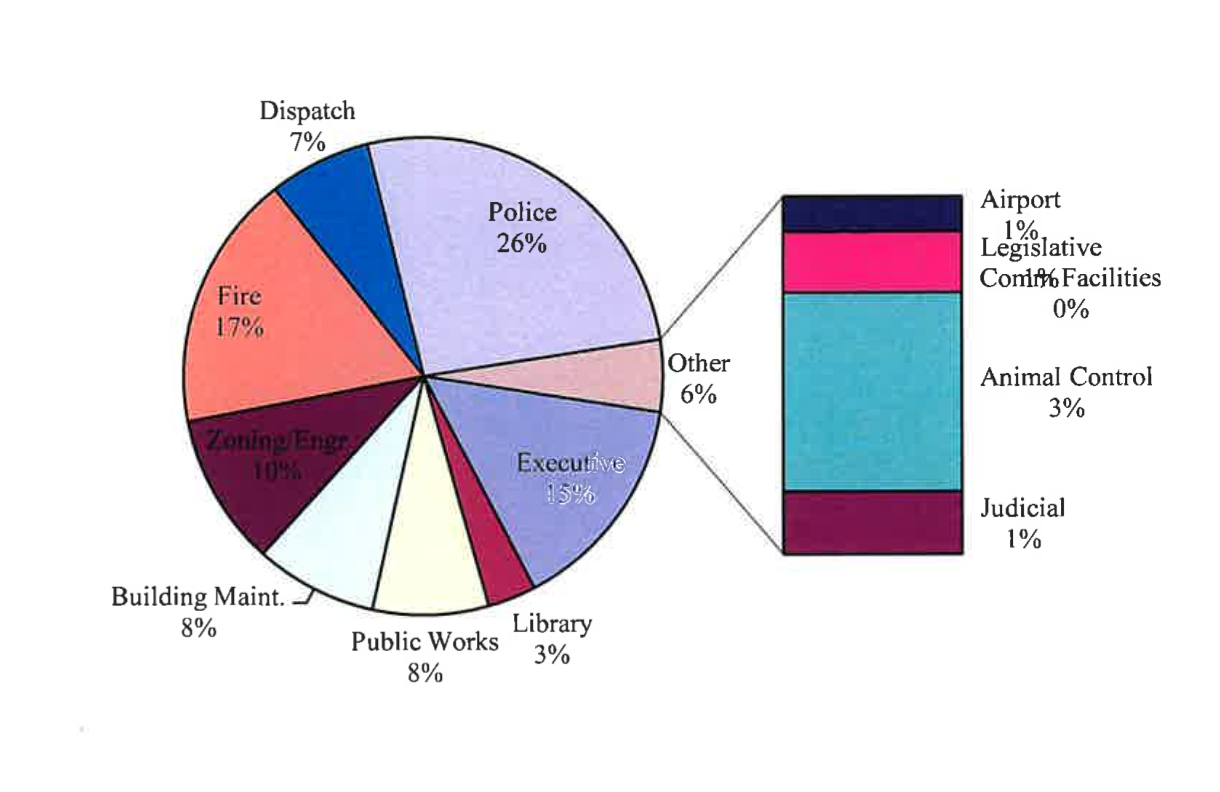
Below is the Final Budget Expenses by Department for the 2025-2026 Fiscal Year
Executive 1,141,115 15%
Library 250,522 3%
Public Works 601,183 8%
Building Maint. 629,378 8%
Zoning/Engr 788,065 10%
Fire 1,332,890 17%
Dispatch 525,061 7%
Police 2,017,088 26%
Airport 36,750 1%
Legislative 63,991 1%
Animal Control 207,737 3%
Judicial 65,831 1%
Total Expenses 7,659,611
The city is required by law to keep a 1/12 reserve or $638,301 for this budget in case of emergencies.
Fiscal Year 2025-2026 saw a revenue shortfall which the city covered with reserves and saw an increase in GRT that was consistently about 6% above budget that also helped cover these expenses. The city is currently in the budget process for the 2026-2027 fiscal year and will provide the state with an interim budget later in May and have a final budget done by July 1, 2026.
The City of Raton has many responsibilities, public safety with Fire and Police, Street Department maintains streets and snow removal in the wintertime. The public works department takes care of the city properties including the many parks that Raton owns. Sanitation which comes with its own special set of regulations not only from the state but the federal government as well, for example the closing of the city landfill and building of the transfer station. The transfer station was another project that took a couple of years to complete because funding came in stages not all at once. A large portion of the city expenses are for salaries and benefits. Health Insurance is one of the benefits that the city has struggled with over the last couple of years as premium costs continue to rise.
Retention has been another issue the city struggles with as some employees get trained and then move on to better paying jobs elsewhere. Those that do stick around have a connection to the community, either family or other connections that keep them here. Those employees are the backbone of the city government. While new blood can bring in new ideas will those new ideas work in the culture of Raton.
What has been presented is a very simplified look at the very complex city budgeting and accounting process. Under each department category are dozens of individual line items that must be tracked and accounted for. The full city budget when printed out is over an inch thick and as Antonucci notes it’s a living document that changes each month as adjustments and changes are required. When you say you want change keep in mind that city government has a funding process that often requires finding the funds to do a project. Finding those funds takes time and can often meet with rejection on the first try or funding may fall short of project requirements. Simply put change won’t happen overnight.