
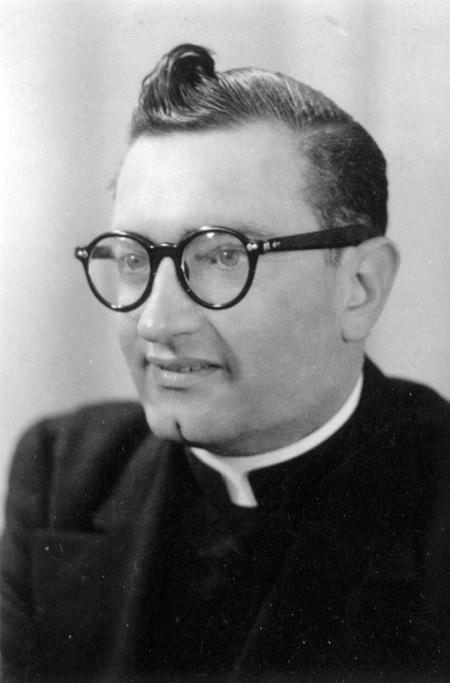
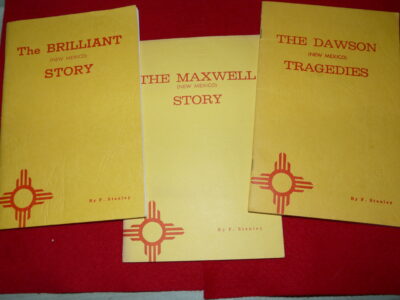
Anyone who reads or researches the history of New Mexico can’t help but chance on the bright sunflower yellow booklets imprinted with a red zia symbol and typeface – the simple cover design that characterized the works of F. Stanley, a Catholic priest, teacher, author and historian. Around 1960 he began publishing these “place booklets”, a paper bound series, each ranging in length from eighteen to twenty-six pages long, dealing with the history of obscure hamlets, villages or ghost towns that he usually entitled “The (Such and Such) New Mexico Story”.
F. Stanley was a nom de plume, used by author Father Francis Stanley Louis Crocchiola. Because of his priestly vocation many assumed the initial in that name referred to his priesthood, addressed with the title Father, but in reality it stood for Francis, a name which Louis Crocchiola took, along with the name Stanley, at the time of his ordination. He chose to use a pen name to show authorship of his writings because Crocchiola was too troublesome for people to pronounce or spell.
As stated by his biographer, Mary Jo Walker, Louis Crocchiola, a.k.a. F. Stanley, was born on Halloween, October 31, 1908, in Greenwich Village, New York. He was the offspring of Italian immigrants, Vincent and Rose Crocchiola, the sixth in a family of eleven children. Walker noted that F. Stanley “made up his mind he wanted to teach” while a junior at DeWitt Clinton High School. At that time, in the late 1920s, the teaching field in the secular world was abounding with job applications so his parish priest recommended “combining teaching with the priesthood”. Vincent Crocchiola was intensely opposed to that suggestion. Undeterred by his father’s misgivings about the religious life, F. Stanley enlisted in the Franciscan Order of the Atonement and was ordained on February 10, 1938, at Immaculate Conception Shrine in Washington, D.C. His first assignment was a teaching position at St. John’s on the Hudson in New York, the seminary from which he had graduated.
Three days into his ecclesiastical career, according to his biographer, “doctors found two spots on his right lung”, making his ministry on the east coast a challenging dilemma. The prescription for healing, however, was simple. He was advised to live in a dry climate with low humidity. Church officials solved the problem by sending him out west, to Hereford, Texas to recuperate, anticipating that the arid climate would aid in his recovery, but by the time a new school year rolled around he was back in New York teaching at St. John’s.
For the next two years, as he accepted his assigned work, F. Stanley bounced around from the east coast to the west coast, his health deteriorating because he wasn’t able to spend a consistent amount of time in an arid climate. Finally, in desperation, he made a plea to his governing board, the Commission of the Archdiocese of New York, petitioning them to find a permanent place for him in a southwestern climate or release him. The board was not able to meet his urgent request, so granted him permission to find another bishop.
F. Stanley severed connections with his religious order, the Franciscans, giving up being a religious order priest to become a diocesan priest, where he served within the boundaries of a diocese under the authority of a bishop. Since he was fluent in the Spanish language, he appealed to Archbishop R. A. Gerken for an assignment in New Mexico, working with the Spanish-speaking church-goers of the Archdiocese of Santa Fe. Archbishop Gerken was happy to oblige, assigning him first as assistant pastor of Our Lady of Guadalupe Church in Taos in 1940 and a year later as pastor of San Miguel Church in Socorro.
His decades as a priest found him living and working in several New Mexico towns, including Taos, Socorro (two stints), Raton, Villa Nueva, Sapello, and Pecos. In addition to Hereford, he also served in the Texas communities of Rotan, St. Francis, Canadian, Stratford, White Deer, Lubbock, Friona, Dumas, Pep, and Nazareth.
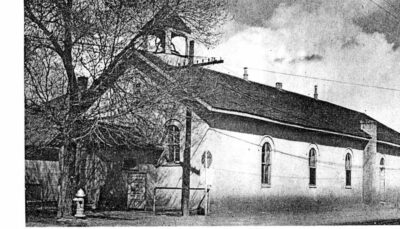
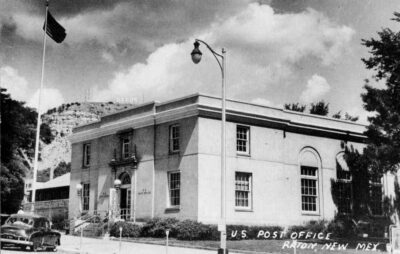
In 1946 F. Stanley accepted a post in Raton, New Mexico, becoming the fifth pastor of St. Joseph Catholic Church, a small adobe structure on Martinez Street in the eastern section of the town. Two years later, working from a former coal camp house turned rectory, he produced his first history book, Raton Chronicle.
Why did he write a book about Raton? A blurb in the local newspaper, The Raton Daily Range, circa 1948, described F. Stanley’s explanation: When he was assigned to his Raton pastorate, he contacted the Santa Fe Archives Department requesting information about New Mexico. The Range reported, “They sent him back a ponderous six-volume set of books. He plowed through all the books and found one page about Raton. He decided this part of the state had been neglected – historically speaking. ‘I decided to give Raton and Colfax county a good workout,’ he related. The ‘workout’ was a steady stream of articles in Catholic and historical periodicals about Raton and other Colfax spots – climaxed by ‘Raton Chronicle‘ – which has had Raton old timers sitting up nights reliving the past.”
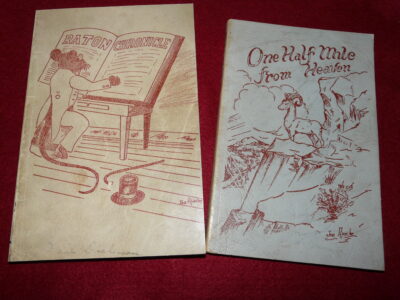
The Raton Chronicle was dedicated to: “The boys who lost their lives in World War II; Wherever they lie, there is a little Bit of Raton”. F. Stanley utilized every possible resource in Raton, as he gathered research for the book, including interviews with native Ratonians, documents of the county clerk’s office, public library material and the files of The Raton Daily Range. He assembled a team of typists, culled from employees of several Raton banks, to transcribe the manuscript. Lina (Giampietri) Cash, Betty (Klantchnek) Marchiondo, Annie Zolin, and Lillian (Frederici) Loftus typed the manuscript, and Raton artist Joseph Apache Sr. designed and illustrated the cover.
The title page of Raton Chronicle states it is for the Raton Historical Society, seeming to imply that the historical group financed the book, but F. Stanley nixed that idea. In his biography he recollected, “In those days you could not publish a book without the authority of the bishop, and he would not give authority. But it could be done under the name of some other group. They (the Raton Historical Society) just gave me the name. Never did I have any penny of financial assistance.” Historical association members listed, in addition to F. Stanley, were: Ada Evlyn Shuler, Emily Long, Mrs. Carl Riddle, Mrs. Kenyon Riddle, Carl Riddle, Kenyon Riddle, and Jay T. Conway.
The book was merely a start for the budding author and historian. He went on to write and publish over 177 books and booklets, chronicling the history of many towns in New Mexico and the Texas Panhandle. He also wrote about the infamous bandit, Black Jack Ketchum, Clay Allison the gunfighter, the Civil War in New Mexico, the Maxwell Land Grant, and the emerging cattle industry in the Texas Panhandle, to name a few. He tirelessly pursued his passion of recording history, spending every spare minute researching and writing, many times spending his vacations in small western towns gathering research. A good portion of his research was conducted by visiting and interviewing golden-agers in the communities he was writing about.
The former New Yorker, sent out west by his superiors to recover his health, became fascinated by the heritage of New Mexico, easily adopting the state as his own. “It’s the most beautiful country I’ve ever seen,” he told Denver Post reporter Valerie Locke in a 1971 interview. “I don’t see how anyone could ever leave it”. The majority of his books and booklets are about towns in New Mexico. According to Locke, the priest turned historian and author, had the lofty goal of writing a book about every town in New Mexico. Locke’s article in the Denver Post posed the question, “What is the importance of such an ambitious project, with many of the towns obscure and some now dead”?
“In his booklet The Yeso (New Mexico) Story, F. Stanley replies: ‘Now and then people talk about places like Yeso, but no one seems interested enough to preserve its history on paper. It may not be exciting or interesting, but it is a place, it has a name, it has people. Yeso may not be important to the man at the wheel trying to make it from California to New York in three or four days, but it is very important to the people who call it home or once called it home…’”
If a place existed, he wanted to get something down on paper about it; he wanted to give the reader the opportunity to glimpse the minutiae of life in a bygone era, in some of the out-of-the-way places in New Mexico. Perhaps this indomitable resolve of F. Stanley’s to record history, knowing that his booklets were only starting points, is what led author Jack Rittenhouse, to dub him “the Johnny Appleseed of history”. The story of Jonathan Chapman, otherwise known as Johnny Appleseed, is a familiar one. Around 1800 Chapman headed west by foot with a supply of apple seeds he had collected from cider presses in western Pennsylvania. On his long trek westward, traveling from the Allegheny Mountains of West Virginia to central Ohio and beyond he stopped here and there, carefully planting the seeds, protecting them from being tampered with by animals. He grew them until they became apple seedlings, then moved along to the next place, repeating the action. He sold or gave away thousands of his seedlings to pioneers so they could start apple orchards.
In the Foreward of Mary Jo Walker’s biography of F. Stanley, Rittenhouse writes, “F. Stanley has wandered across the southwest like a Johnny Appleseed of history, planting seedlings in the form of booklets and leaving their later nurturing to others. Later historians will convert these seedlings into trees by pruning, fertilizing, and grafting. The work will require more research, more verification, correction and amplification. But F. Stanley planted the first seed.”
A Catholic priest’s duties are many and varied, some of which include conducting daily Mass and a weekly Sunday service, preaching the word of God and the truths of the faith, providing for Catholic education, administering the sacraments, and tending the sick. How does a priest serving his parish find time to research and write history books? F. Stanley said in Locke’s Denver Post article, “I force myself to make time. Most of my church work is on Saturday and Sunday. During the week there is a lull when people are working. That’s when I have time for my research and writing. The busiest man in the world has time for others. It’s the man who doesn’t know where he’s going who never has time”.
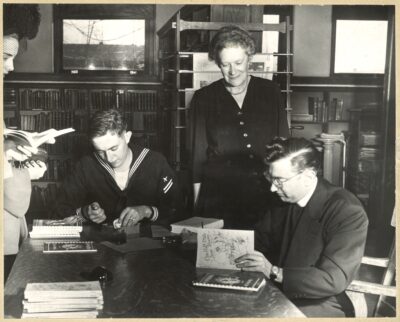
Since the Catholic Church did not bankroll his writings, F. Stanley was on his own for financing the printing of his books and booklets, preferring to delay payment until the books were sold. By his own efforts, without aid or support, it was up to him to boost visibility and sales of his titles. Each book or booklet was limited to a press run of four or five hundred copies, with a few exceptions, notably The Grant that Maxwell Bought (250 copies)and Desperadoes of New Mexico (800 copies).
F. Stanley used World Press of Denver, Colorado to publish his books until 1960, when that company’s exorbitant prices forced him to switch to a couple of Texas printers – Pampa Print Shop and Jim Hess Printers in Borger. For some unknown reason, he never used a New Mexico printer to put out his work.
“An easterner by birth but a south westerner at heart, Father Francis Stanley Louis Crocchiola had as many vocations as names,” wrote his biographer Mary Jo Walker. “As a young man, he entered the Catholic priesthood and for nearly half a century served his church with great zeal in various capacities, attempting to balance the callings of teacher, pastor, historian and writer. With limited money or free time, he also managed to write and publish 177 books and booklets pertaining to his adopted region…”. Apparently living in an arid environment suited the New York born priest who loved the southwest, for he lived to the age of eighty-seven. He is buried in the Nazareth, Texas cemetery.
Nowadays F. Stanley’s books and booklets have reached the status of collector’s items, and are priced accordingly. Ebay Auctions is currently offering the bright yellow New Mexico “place booklets” at a price range of twenty to thirty-five dollars each. His books, depending on rarity, have become big-ticket items. For example: the asking price on Abe Books for Clay Allison is $800.00. This seller also has several copies of Raton Chronicle for sale, varying in price from $100.00 to $150.00. The Grant that Maxwell Bought is presently listed on Buckingham Books with a hefty price tag of $1750.00 attached! F. Stanley would be pleasantly amazed!
Be First to Comment