So, What’s the Big Deal…About the New Deal?
By Pat Veltri
The Great Depression
HUNGER… UNEMPLOYMENT… HOMELESSNESS… POVERTY… were the bleak realities permeating the stark merciless existence of those living during the era of the Great Depression. The Great Depression, a devastating and prolonged economic recession that followed the crash of the United States stock market in 1929, is often cited by historians and economists as the greatest and longest economic recession in modern world history. The Depression ran from 1929 through 1941, when preparations for World War II began stimulating the American economy.
During the Great Depression, breadlines and soup kitchens dotted the streets of American cities, and hundreds of Hoovervilles cropped up across the country. Hoovervilles were shanty towns built by unemployed people who had been evicted from their homes. They were called Hoovervilles after Herbert Hoover who was president of the United States at the onset of the Depression. Many looked to the federal government for assistance as the Depression worsened. When help didn’t materialize, Hoover was blamed for the intolerable economic and social conditions; hence the shanty towns were dubbed Hoovervilles.
During the Depression households were more or less compelled to embrace the habit of thrift. Bottles, paper bags, jars, and tin cans were reused. People planted backyard gardens, learned to repair household items, made handmade toys, used oil lamps for lighting and patched worn-out clothes. Since new clothes were not affordable many women began sewing clothes of cotton flour sacks. Flour companies noticed this and began creating the sacks with colorful patterns, which often included instructions for sewing ideas on the package. The average American family lived by the Depression-era mantra: “Use it up, wear it out, make do or do without.”
A New Deal
Relief from the continued tribulations and hardships of Depression-era life came to the American people in the person of Franklin Delano Roosevelt. Roosevelt, the governor of New York, was nominated as the Democratic Party’s presidential candidate in the summer of 1932. According to the Library of Congress website, Roosevelt addressed the problems of the Depression by telling the American people that, “I pledge you, I pledge myself, to a new deal for the American people.” He handily defeated incumbent Herbert Hoover by a landslide in the presidential election that took place in the fall of 1932.
Roosevelt didn’t waste time; almost immediately after his inauguration in March, 1933, the promised New Deal began to come together. David Kammer, Ph.D., a New Mexico cultural and architectural historian, observed that Roosevelt “brought to the White House a new vision of the role of government.” Kammer wrote in a New Mexico Humanities newsletter, “In pursuing his goal to restart the nation’s economy and restore people’s belief in themselves, Roosevelt sought to provide work relief jobs to the unemployed that were not simply a dole but aimed at restoring their sense of dignity. These federally funded jobs would enable people to get back on their feet and also improve the quality of public life in their local communities.”
Based on the premise that the power of the federal government was needed to get the country out of the Depression, the first days of Roosevelt’s stewardship saw the passage of banking reform laws, emergency relief programs, work relief programs and agricultural programs. Still more came later, including programs to aid migrant workers, the Social Security Act, the Tennessee Valley Authority, and the Federal Deposit Insurance Corporation.
Acronyms R Us
FDR’s New Deal platform spawned an incredible number of federal agencies to carry out new policies and regulations. Almost all of these agencies were known by an acronym, like the CCC, TVA, or PWA. Additionally there was the WPA, REA, FERA and SCS; and there was more, including the PWAP, TSFA, TRAP…get the deal? There were so many agencies they came to be known as FDR’s Alphabet Soup Agencies, or FDR’s Alphabet Army. The following are some of the agencies that were a big deal to Depression era Raton, New Mexico:
PWA(Public Works Administration): Internet sources Britannica and Wikipedia describe the PWA as a New Deal government agency, created by the National Industrial Recovery Act in June, 1933. Headed by Secretary of the Interior, Harold L. Ickes, the PWA was designed to reduce unemployment, increase purchasing power and revive the economy through the construction of large-scale public works such as dams, bridges, highways, hospitals and schools.
WPA (Works Progress Administration): History.Com Editors state that the WPA was “an ambitious employment and infrastructure program created by President Franklin Delano Roosevelt in 1935, during the bleakest days of the Great Depression.” The WPA, which was renamed the Work Projects Administration in 1939, was headed by Harry Hopkins. It focused on smaller projects and hired mostly unskilled, unemployed workers.
Federal Project Number One (Federal One): In addition to its well-known building and infrastructure projects, the WPA also managed a set of programs collectively referred to as Federal Project Number One, generally known as Federal One. These programs employed artists, musicians, actors and writers. History. Com Editors report that “Roosevelt intended Federal One to put artists back to work while entertaining and inspiring the larger population by creating a hopeful view of life amidst the economic turmoil.”
TRAP(Treasury Relief Art Project): Internet source Britannica identifies the Treasury Relief Art Project as the smallest of the federal visual arts projects developed under the New Deal to help Depression stricken American artists in the 1930s. Directed by the painter Olin Dows and designed to embellish federal buildings, it was operated under the procedures of the US Department of the Treasury and funded by the WPA.
The New Deal: A Good Deal or a Raw Deal?
For decades historians have been debating the successes and failures of the New Deal. Currently the conclusion seems to be a mixed bag. On the plus side the New Deal, through programs such as the Civilian Conservation Corps (CCC) and the Works Projects Administration (WPA), gave jobs to millions of unemployed Americans and helped gussy up the country’s infrastructure. Also, measures such as Social Security, the Federal Deposit Insurance Corporation, the Securities and Exchange Commission, and the Tennessee Valley Authority, were set up to improve long-term economic growth in the United States.
However, the New Deal has not been considered a complete success, primarily because it failed to end the Depression. Many historians concur that the Depression ended because of the economic boost provided by World War II. The production of a massive amount of war goods, including ships, tanks, ammunition, arms and war planes significantly increased government spending, created jobs and mobilized the economy.
The New Deal: A Sweet Deal for Raton?
The answer would have to be a resounding yes! Here’s how:
• The New Deal helped reduce unemployment for hundreds of Raton’s skilled professionals, non-skilled laborers and artists. (School Construction, Drainage Ditches, Courthouse Construction, Armory and Football Stadium Construction, Commissioned Paintings/Murals)
• The New Deal Public Works agencies modernized Raton’s infrastructure. (New School Facilities, New Colfax County Courthouse, Flood Control Project)
• The New Deal beautified some of Raton’s public spaces. (Post Office Murals, Commissioned Artwork at the Library, Shuler Theater Murals, El Portal Murals)
• The New Deal improved military preparedness. (Raton National Guard Armory)
Highlights of Raton’s New Deal Legacy
Infrastructure
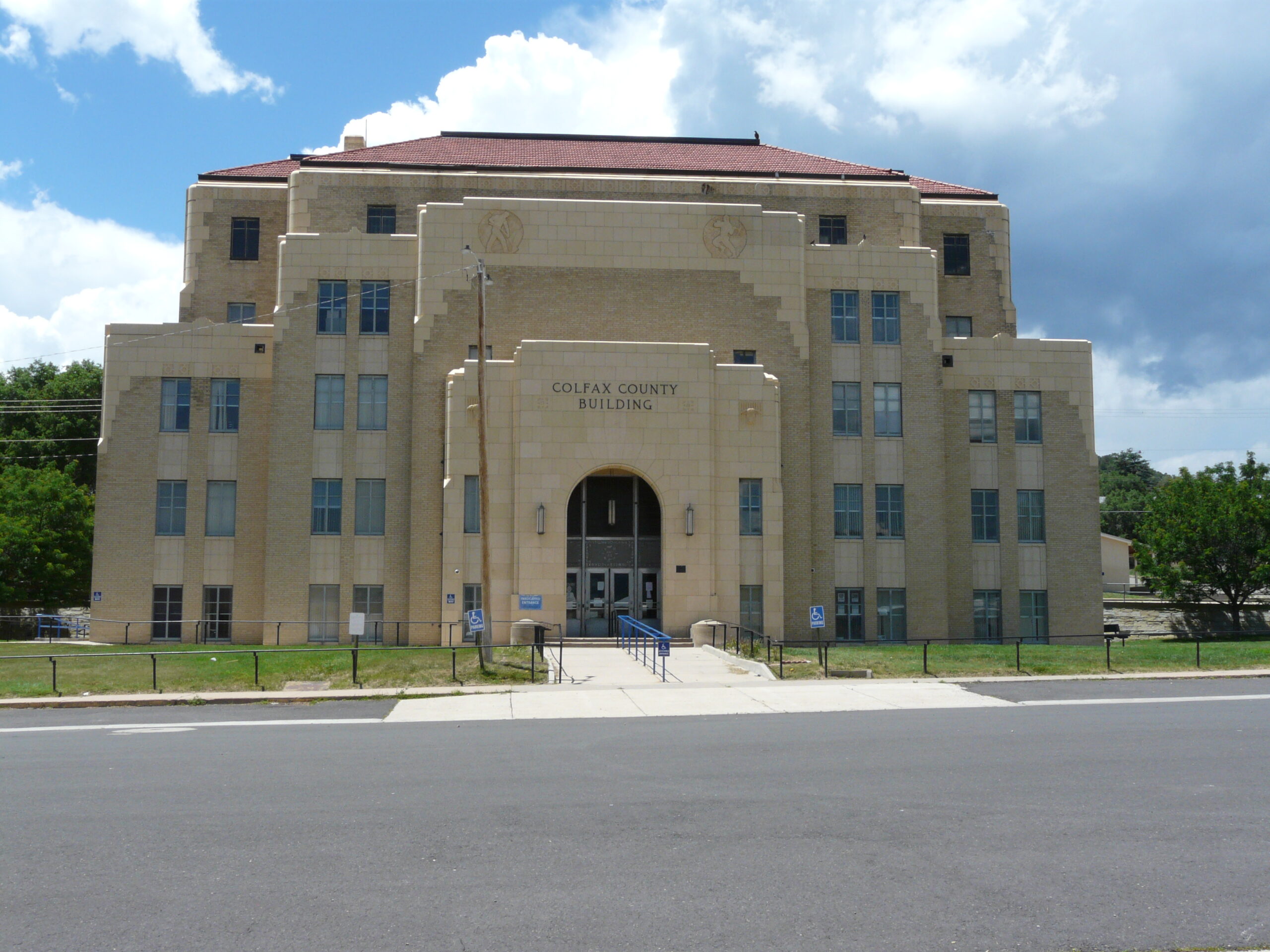
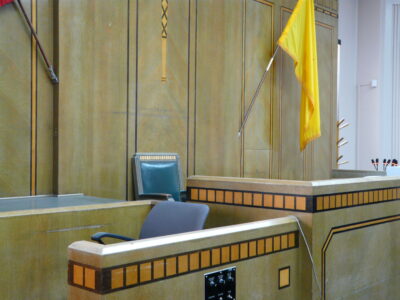
Colfax County Courthouse Approaching the century mark, age wise, the Colfax County Courthouse, located at 230 North Third Street in Raton, is an architectural marvel listed on the United States National Register of Historic Places and the New Mexico State Register of Cultural Properties. The courthouse was constructed with funds from the New Deal’s Public Works Administration (PWA) and a local bond issue promoted by Raton’s citizens. The overall price tag for the project was $272,377 with the PWA providing a $110,455 grant, supplemented by the local bond issue which passed to the tune of a little over $160,000. Construction began in 1936 and the building was completed a year later. Raton contracted architects Townes and Funk of Albuquerque, New Mexico and Amarillo, Texas to take on the responsibility of designing the new structure, while a Trinidad, Colorado based architect, R.W. Vorhees, was hired to oversee construction.
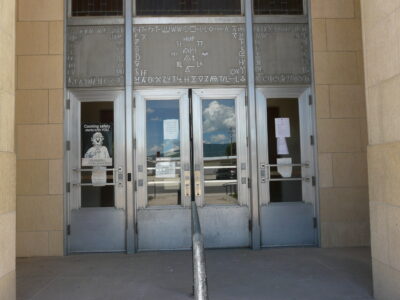
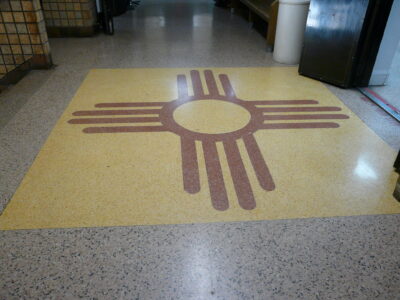
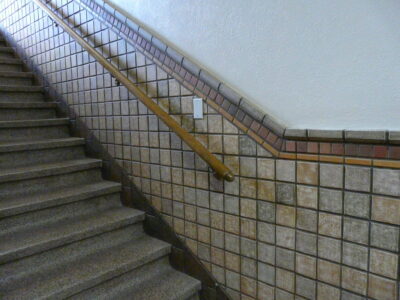
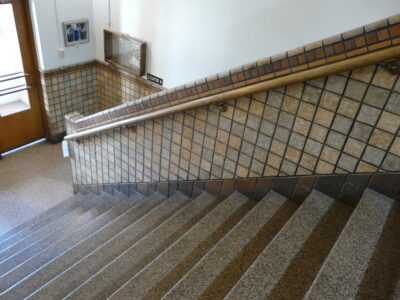
Architectural Historian David Kammer, Ph.D. says the Colfax County Courthouse “is generally considered the second best Art Deco Style courthouse in the Southwest, after Bisbee, Arizona.” John E. Deacon, Attorney and Courthouse Historian, offers this description, which explains how the courthouse earned the “second best” distinction, “The building faces east and is a five story light colored brick and concrete structure. The building is located on landscaped grounds in the center of Raton. The east front has white colored stone around the entrance arch. Area ranch cattle brands decorate the space above the entrance. Embellishments include glazed tile cornices, and bas-reliefs depicting local farming, mining and cattle raising. The fifth story is recessed. The roof line has white colored stone trim and there is a chipped-tile roof on the top story and flat roofs on the lower areas. The interior has terrazzo floors (with an inlaid Zia symbol on the main floor) and tile wainscoting.”
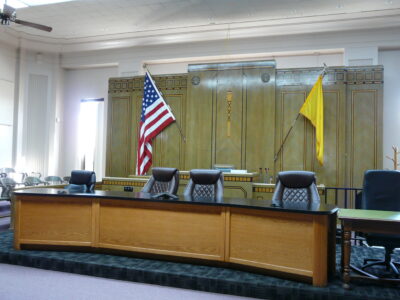
Update: In 2010 a new legislative building, the Leon Karelitz Judicial Center, was completed in the south end of Raton. The contemporary judicial hall currently comprises the District and Municipal Courts. While the historic courthouse is no longer used for court purposes, many other departments and offices, including those of Assessor, Treasurer, Fire Chief, Extension Agent, Drafting and Mapping, Probate Judge, County Manager, Solid Waste, Lodgers’ Tax and Tourism continue to perform administrative functions for Colfax County. At present the former Deco style courtroom on the third floor provides a meeting place for the County Commissioners.
The Raton National Guard Armory and High School Football Stadium
Raton’s National Guard Armory, listed on the National Register of Historic Places, was built with funds from the Work Projects Administration (WPA)
towards the end of the New Deal era. The federal government was shifting its priorities as it became evident that the United States was being drawn into the turbulence of world events that was leading towards World War II.
The National Guard and the Raton Board of Education entered a partnership of sorts for a football stadium and armory project. Plans were for the stadium and armory to be constructed as a WPA project, on a tract of land located south of American Legion Field. The Board of Education had purchased the land parcel from the Santa Fe Railroad. The final price tag for the joint enterprise was $162,000.
The project was rushed through the red tape largely as a national defense feature and received speedy approval because of the National Guard connection and the necessity to house the local Guard unit. The Raton Reporter newspaper, November 21, 1940, stated, “The stadium is, in effect, a part of the armory project. It will adjoin, and will be built simultaneously with the armory. Hence it, also, is a national defense project, and entitled to quick construction.” The Raton Daily Range, December 21, 1940, noted it would take 100 WPA workers about a year to finish the entire job.
According to David Kammer a $121,000 appropriation was made in November, 1940 by the WPA “for the construction of a modern armory in Raton.” Kammer notes, “As with other armories, the intent of the building was multiple. To meet the needs of the artillery battalion that was posted there, the building included vaults for arms, a shooting range, a kitchen and mess hall, and quarters for a member of the Guard who provided security. At the same time, the building was also intended to serve as a community and recreation center for Raton and included a gymnasium/auditorium and meeting rooms.”
Update: In 1973, the New Mexico National Guard deeded the armory building to the Raton Board of Education. The board used the building as a meeting place/recreation center through the 1980s, then transferred title to the city of Raton. The city renovated it for use as a convention center. Nowadays, it is known as the Raton Convention and Recreation Center.
New Deal Schools: Kearny Elementary, Columbian Elementary, Longfellow Elementary, Raton Junior-Senior High School (currently known as Raton Intermediate School)
Kearny Elementary
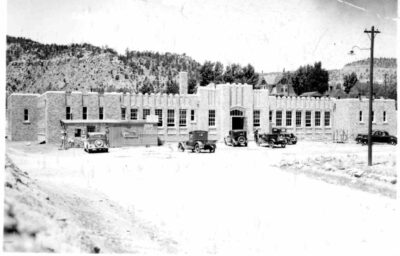
The Kearny School building at 800 South Third Street was built in 1936 as part of a Public Works Administration (PWA) project under the New Deal. Initially the school was known as South Side Grade School, but in December, 1936 the school’s name was officially changed to Kearny, in honor of Stephen Watts Kearny, Commander of the Army of the West.
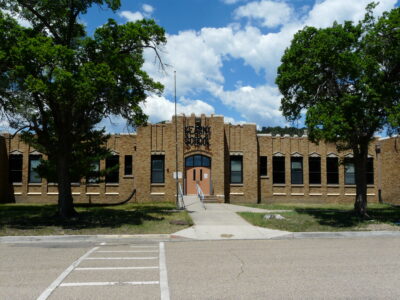
In 1996 the school, built in the Art Deco architectural style, was listed in the United States National Register of Historic Places.
Longfellow Elementary
Longfellow School at 700 East Fourth Street, still in use as an elementary school, was built in 1939 as a Work Projects Administration (WPA) project. The “L” shaped structure was designed in the Moderne architectural style by the WPA’s official architect, William C. Kruger, who had grown up in Raton.
Longfellow is a one-story brick building that was remodeled in the 1960s by the addition of four classrooms to the south and a library to the rear which does not detract from its historic aesthetic.
Initially plans called for the demolition of the old Longfellow School, and the new building to be constructed on the same site. However, these plans changed in the spring of 1939 when the A.T.& S. F. Railway donated a five acre parcel of railroad land to Raton. Located east of the railroad tracks, the new location meant that the neighborhood east of the tracks comprised of many railway workers and their families would have a “neighborhood school”.
Columbian Elementary
The Columbian School at 700 North Second Street was built in 1939 as a Work Projects Administration (WPA) project. The “old” Columbian school, built in 1906, was razed and the new “L” shaped structure was built on the same site.
Listed on the National Register of Historic Places in 1996, Columbian was also designed by architect William C. Kruger in the Moderne architectural style. Additions were made to the school in 1950 and 1970 but do not diminish its historical distinctiveness.
Raton Junior-Senior High School ( Raton Intermediate School)
Raton Intermediate School, historically known as Raton Junior-Senior High School, was a Public Works Administration project (PWA). Construction began in 1938 and was completed in 1939. The building was listed on the National Register of Historic Places in 1996.
Update: Kearny Elementary School and Columbian Elementary School, both part of the Raton Public School District for decades, were closed in 2016. Kristie Medina, Superintendent of the Raton Public Schools, says, “Columbian Elementary and Kearny Elementary Schools in Raton, New Mexico, were both closed in 2016 due to a combination of declining enrollment, aging infrastructure, and district-wide consolidation efforts.” Jason Phillips, President of the Raton School Board, adds, “While I was not on the board at the time, my understanding is that with decreased enrollment there was less funding available to provide for the maintenance of the buildings, and to fund the additional administrative positions required to operate them. Kearny School additionally had structural issues that needed to be addressed and that caused concerns regarding staff and student safety.”
In 2023 Raton voters passed an $8 million school bond issue by an overwhelming margin. The state of New Mexico has agreed to kick in the remaining millions to construct an estimated $109 million state-of-the-art Pre-K – 12 campus in Raton.
Once the new campus is built, Longfellow School, Columbian School and Raton Intermediate School will be slated for demolition, as of now, according to Medina. Phillips explains, “The state will no longer provide any funds for things like insurance and upkeep of the structures once they are vacated. The Board of Education would entertain other possible disposal methods of the properties in accordance with state law but the reality is there are few, if any, entities that have the resources to maintain and operate buildings of this size and in their current condition. Keeping the properties under the umbrella of the Raton Public Schools would deplete already limited funding that is used to educate our student body.”
Thus far the lone New Deal School in Raton to dodge the wrecking ball is the Kearny building. The city of Raton is the new owner. Medina says, “The city of Raton acquired the former Kearny Elementary School through a land swap agreement with the Raton Public Schools. In this exchange, finalized in 2021, the city received the Kearny School property located at 800 South Third Street, while Raton Public Schools obtained a parcel of land adjacent to the district’s Tiger football field. This strategic trade was approved by the New Mexico Department of Finance authority and was designed to facilitate the redevelopment of the Kearny building into a film and media training center, thereby supporting local economic development and workforce training initiatives.”
Supported by funding from the U.S. Economic Development Administration, the U.S. Department of Housing and Urban Development and New Mexico State Capital Outlay funds, the city of Raton and El Raton Media Works, a non-profit organization, is partnering to renovate the Kearny school building to create the Kearny Film School and Education Center. The 20,000 square foot building will be “re-purposed into a state-of-the-art film and media training center with a cutting-edge XR studio, bringing high-tech capabilities and workforce development opportunities to northern New Mexico…” as reported by a press release from KRTN Enchanted Air Radio. The remodel went out for construction bid in January, 2025.
Phillips states, “Sealed bids were received that exceeded the City’s available construction budget for the complete building renovation. The City is working with their architect to revise the scope of the renovations to match the budget. Construction is expected to take place in 2025.”
Stone Drainage Channels
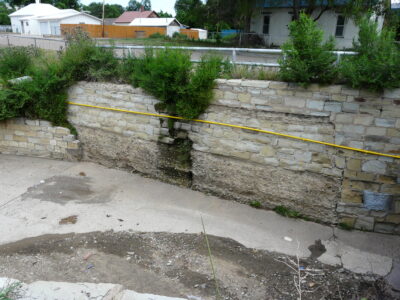
The Work Projects Administration (WPA) provided jobs for hundreds of out-of-work Ratonians during the building of a system of drainage channels, or ditches, for the city of Raton. While bears nap in them, or wander through them foraging for food, children often explore them and vandals mark them with graffiti, the stone drainage channels continue to serve the purpose for which they were intended: redirecting water runoff from Goat Hill and the surrounding canyons. Jason Phillips, wearing a different hat – that of Deputy City Manager/Public Works Director for the city of Raton – recalls playing in them as a child and notes he has always been fascinated by them. Phillips explains why the drainage channels were constructed, “From what I have been told and read, the channels were existing arroyos that would overtop and erode in larger weather events. The purpose of the rock-lined channels was to stabilize these ditches and increase their capacity to prevent flooding of properties.”
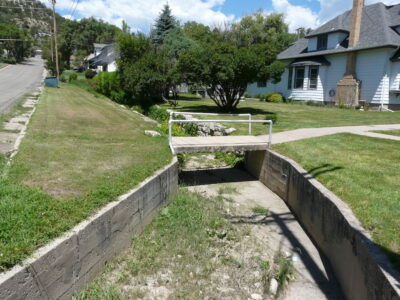
Nearly eight miles long (about 40,000 linear feet of ditch), Raton’s rock channels are constructed of stacked stone gathered from a couple of local quarries, one located west of the present water filter plant and the other situated in the area of Railroad Canyon.
According to Phillips, most of the ninety year old ditches, “are on the west side of town with the exception being the large drainage channel that runs underneath Highway 72 near Alpine Lumber.”
The WPA flood control projects took place in phases. Construction for what was labeled in newspaper coverage as the Mora Avenue Flood Improvement Project was approved in December, 1935, and the completion date for the project was July, 1936.
Probably the most extensive, and certainly the most costly, of Raton’s ditch project proposals was submitted to the WPA on March 9, 1937. The city and county planning boards gave the go ahead for the projects.
The cost estimate on the proposal was a staggering $221,830.20, with Raton’s share of expenses expected to be $23,750. Archival records state the description of the project: “construct rubble masonry channels from Scenic to Sugarite Avenue, Collier Avenue to Raton Arroyo, Eighth to Sixth Street and in Wersonic Addition on Seventh Street; construct storm sewers on Fifth Street and Apache Avenue; excavate and riprap drainage ditch around Goat Hill; perform appurtenant work, primarily for road and street drainage.”
Lea Rowland, state WPA administrator, approved the request for funds on June 6, 1937, but the project did not receive federal approval until about a year later. August 3, 1939, was given as an estimated date of completion, but the actual completion date was not mentioned in archival sources and local newspapers.
Update: Raton’s rock channels were skillfully put together which accounts for their longevity. “These rock-lined channels are still the backbone of the drainage system in Raton,” says Phillips. “They were designed in such a way that they are a testament to the craftsmen of the time. Their replacement cost would be in the tens of millions of dollars if constructed today.”
Phillips says the city of Raton “spends hundreds of man hours” maintaining the rock channels. “Time has taken a toll and some sections of walls and floors are in constant need of repair. In addition, City of Raton crews constantly have to remove sediment from sections of the channels and vegetation and elm tree growth from the adjacent areas. Even with our best efforts we are consistently behind where we would like to be maintenance wise. Some channels do not have access where proper maintenance and tree removal is possible.”
Highlights of Raton’s New Deal Legacy
Culture
Arthur Johnson Memorial Library
Located at 244 Cook Avenue in the downtown area of Raton, the Arthur Johnson Memorial Library was originally built as the town’s post office, opening for business in 1919, a couple of decades before the onset of the New Deal. Once the building reached the age of fifty, Raton was earmarked for a new post office.

When the new post office was built in 1969, the United States Government offered the city of Raton a thirty-year lease for one dollar on the old building, still in good shape, with the proviso that it be used as a library. The library took the name Arthur Johnson after a Raton banker, whose widow donated a substantial monetary gift for new furniture for the library. Once the thirty-year obligation was fulfilled, ownership of the building was ceded to Raton. In the late 1990s the library experienced a huge makeover that included the addition of an elevator and the opening up of the second floor for public use.

What’s the big deal about the library? From a New Deal standpoint the library is significant in two ways. To begin with, two New Deal murals were created specifically for the building, when it was still a post office. The two works, “First Mail Crossing Raton Pass,” and “Unloading the Mail at Raton,” were commissioned by the Treasury Relief Art Project (TRAP). They were completed by American muralist Joseph Fleck in 1936.
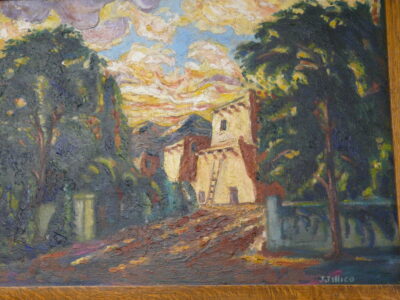
Furthermore, the library is home to a treasure trove of paintings, hanging in every part of the building, several of which are representative examples of New Mexican artists of the New Deal era.

Many of the New Deal paintings housed in the library were commissioned by the WPA, by way of the Federal Art Project. Some examples of WPA artists represented in the library’ collection include: Odon Hollenkramer, Jozet Bakos, John Jellico, Regina T. Cooke, Paul Lanz, Kenneth Adams, W. P. Henderson, Polia Pillin, Willie Warder and Mike Zomich. Just as an aside, New Deal artist John Jellico, a Colfax County native, born in the coal camp of Koehler, was the founder of the Art Institute of Colorado.
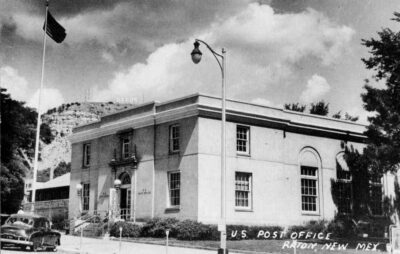
Update: The two New Deal murals have been relocated. “First Mail Crossing Raton Pass” can be found in the retail lobby of the present Raton Post Office. Possibly this mural has been cut to accommodate a doorway, and it also appears to have some water damage. “Unloading the Mail at Raton” has found a new home in the Raton Museum.

In 2023 Arthur Johnson Memorial Library received a soft remodel and the art collection was reassessed. Dennie Gum, Library Director, issued an invitation to patrons: “Experience the updated art collection at the Arthur Johnson Memorial Library! Following our recent remodel, many paintings have been thoughtfully relocated, and exciting new pieces have been added to our walls. A new walk through guide will be available soon to help you navigate these changes and discoveries. We encourage you to visit and explore the library’s art.”
Murals in the Shuler Theater
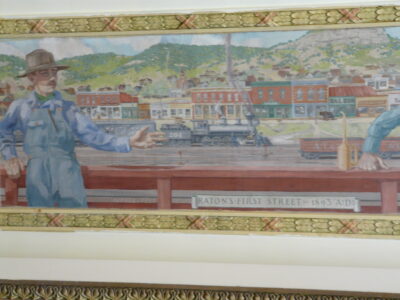
The elegant lobby of Raton’s historic Shuler Theater is the permanent home to eight Public Works Administration (PWA) murals by New Deal artist Manville Chapman. The murals, which depict the history of Raton and surrounding areas, were rendered by Chapman during the years 1933-34. The titles of the murals are: Cheyenne Village, 1845; Wooten Toll Gate, 1868; Willow Springs Ranch, 1870; Clifton Station, 1875; Maxwell’s Mansion, 1865; Elizabethtown, 1885; Raton First Street, 1893; and Blossburg Mine, 1895.
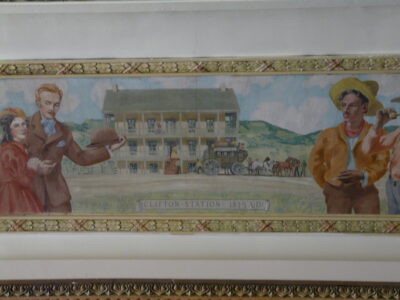
Chapman, son of a Colfax County pioneer, was born in Raton in 1903. He was a graduate of Raton High School and the University of Iowa and studied at the Art Institute of Chicago, as well as the Pratt Institute School of Art in New York. Chapman participated in several New Deal projects, including the creation of woodcuts for the opening of the Roswell Museum, but he is best known for the Shuler Theater murals. He was also an art instructor for potential New Deal artists and other aspiring art students in Raton. He lived in Taos for a while, and moved to California during World War II where he was in charge of aircraft catalog production for the Douglas Aircraft Company.
Chapman’s talents were not limited to art work; he was also a writer, particularly for New Mexico Magazine. Once he completed the murals he compiled a written pamphlet entitled “Blazed Trails: A Series of Colfax County Historical Narratives” based on the Shuler mural paintings. This booklet, written by the artist, was published in 1935 as a PWA project.
Update: In reference to the Shuler mural paintings, Bill Donati, President of the Shuler Restoration Committee, Inc. says, “For being over ninety years old, the paintings are in excellent condition, which not only shows the artistry but the craftsmanship of the era that endures. A real treasure!” The Shuler Restoration Committee is a non-profit organization, formed in 1974, to receive donations and grants for the ongoing restoration and maintenance work of the historic theater. The Committee recently published a reproduction of Manville Chapman’s pamphlet “Blazed Trails: A Series of Colfax County Historical Narratives”, which is available to the public for a monetary donation.
El Portal Murals
Also known as the Seaberg European Hotel, the El Portal Hotel covered half a city block of North Third Street in downtown Raton. The El Portal Hotel was built by a Swedish immigrant, Hugo Seaburg. Seaberg, an attorney interested in commercial enterprises, moved to Raton in 1903, seeking prosperity. With loans and capital he had accumulated, Seaberg purchased a livery stable and began the remodeling necessary to create a hotel on that site. Built in stages, with accommodations for 400 rooms, the hotel earned the distinction of being the largest hotel in New Mexico during the early part of the twentieth century.
The Living New Deal, an Internet source, states that the El Portal displayed a variety of art work in its lobby areas, including large murals created by New Deal artist, Manville Chapman and six others by one of his students, Willie Warder, also working under the auspices of a New Deal agency.
Living New Deal also notes that the hotel housed the original Work Projects Administration (WPA) office for the region and was the location of WPA-supported art classes.
Update: Sadly the hotel suffered a devastating fire in November, 2012, and burned to the ground completely. The good news is that no lives were lost. The murals, however, were destroyed.
.